
In this in-depth guide, you’ll find everything you need to know about babysitting costs in Norway, from teenage sitters to professional nannies. We’ll break down the average hourly rates, how much to pay based on age, experience, and location, and how extra tasks like cooking or caring for multiple children can impact the rate.
Wondering what a babysitter costs in Norway in 2026? Whether you need a teenager to watch the kids occasionally or you’re looking for an experienced professional, prices vary widely depending on age, experience, and responsibilities. In this guide you’ll find average hourly rates, practical examples, and tips on how to set fair and sustainable pay for your babysitter.
According to internal data from Sitly, the average hourly rate for a babysitter in Norway in 2026 is around NOK 120. But note: this is an average that covers many different situations. In practice, prices can vary significantly – from around NOK 100 per hour in smaller towns and rural areas, to over NOK 140 per hour in the largest cities like Tromsø and Oslo, depending on the babysitter’s age, experience, and tasks. In other words – the cost of a babysitter is far from universal: it depends on who you choose and what your needs are. Depending on the type of babysitter you hire, the hourly rate can vary considerably:
- An 18-year-old working as a babysitter only occasionally will typically ask for lower pay.
- An experienced babysitter with specialised training will naturally charge a higher rate.
Do Babysitters in Norway Have a Statutory Minimum Wage?
Unlike some other countries, Norway has no general minimum wage set by law. This means there is no single national hourly rate that applies to all workers, including babysitters. Instead, pay is normally determined by agreement between employer and employee, or through collective agreements in sectors where these are common.
For certain occupational groups and sectors — such as construction, cleaning, and hospitality — so-called generally applicable collective agreements set a mandatory pay level. But this does not apply to babysitting work, which is not covered by such agreements. This is why it is especially important for parents and babysitters to agree together on a fair wage, based on responsibility, experience, tasks, and local price levels.
Hourly vs. Fixed Babysitting Rate: What’s Common?
Most babysitters are paid by the hour, especially when the care is occasional, flexible, or last-minute. It’s the fairest way to match compensation to time and effort. However, in some situations — like a regular weekly shift or a quiet evening when the kids are already asleep — families and babysitters may agree on a fixed or flat rate instead.
What to Keep in Mind When You Decide on an Hourly or Fixed Babysitting Rate
- Hourly payments are best when schedules vary, duties may change, or you sometimes need help on short notice. You pay for every hour (or partial hour), ensuring your babysitter is fairly compensated — even when plans shift or extra tasks arise.
- Fixed or flat rates work well when the arrangement is predictable: for example, every Saturday night from 6 to 11 p.m., with no extra chores involved. It’s easier to budget and keeps things simple for both parties.
What to Keep in Mind if You Use a Fixed Babysitting Rate
Even with flat rates, many parents choose to add a bonus for extra duties — like staying later, helping with dinner, or managing a more demanding evening than usual.stability you have agreed on.
Always clarify what the fixed rate includes: number of children, whether light housework is expected, if travel or late-night hours are involved, etc. Make sure your flat rate doesn’t underpay the babysitter if the workload unexpectedly increases.
Example: You agree on NOK 500 fixed for an evening of 5 hours, where the children go to bed early and the babysitter can relax for the rest of the time. But if you ask her to come earlier, cook dinner, or stay longer than usual, you should add an extra amount based on the hourly rate.
What Should You Pay a Student Babysitter?
If you hire a student as a babysitter, expectations differ slightly from those for professional babysitters with formal training or permanent employment. Students often take on childcare alongside their studies and tend to work evenings and weekends.
In Norway, it is common to pay a student between NOK 100 and NOK 150 per hour, depending on tasks, time of day, and experience. For a simple evening shift where the children are already in bed, NOK 100–120 may be appropriate. If the student also cooks dinner, helps with homework, or looks after several children, it is reasonable to offer NOK 130–150/hour.
Tip: Be clear about expectations: is the babysitter only required to be present, or to actively play, cook, and follow bedtime routines? Remember that students also value predictability and fair pay — especially if you want to use the same person regularly. The most important thing is to find an arrangement that feels fair to both parties — and to put everything in writing if possible.
Infographic for Calculating Babysitter Rates Based on Tasks
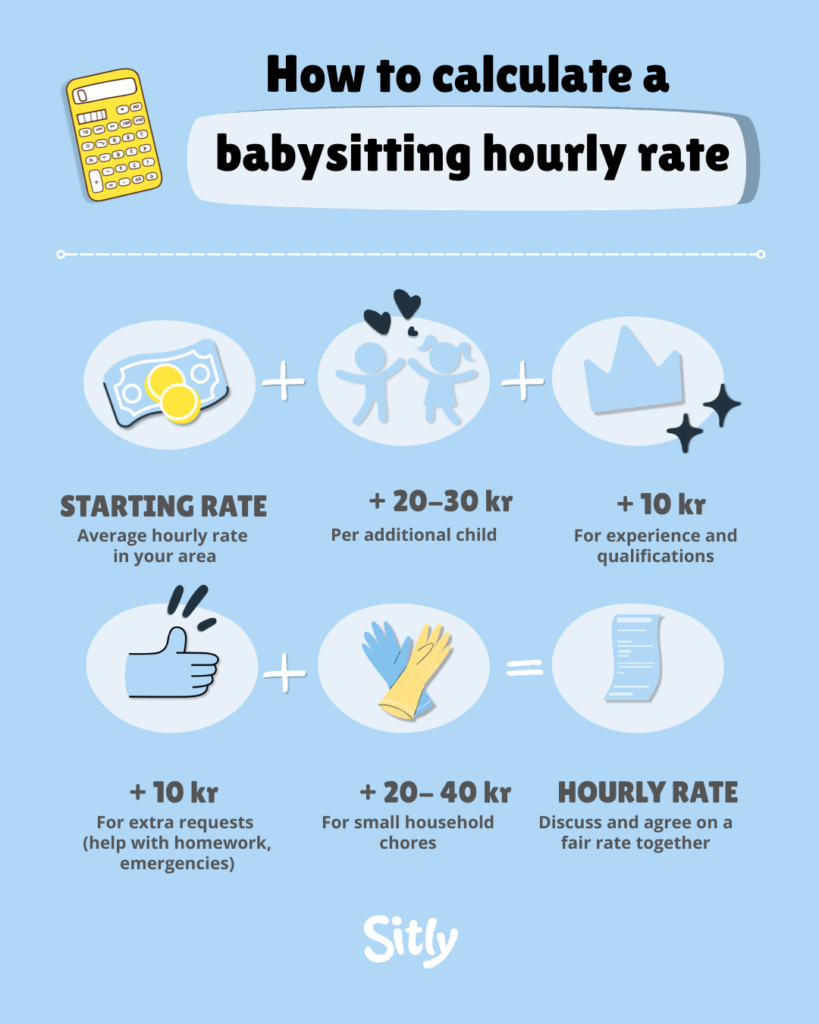
What Are Your Babysitter’s Tasks?
A babysitter’s hourly rate depends not only on age and experience — but also on the tasks she carries out. If you expect her to take on extra responsibilities, it is reasonable for that to be reflected in the pay.
Examples of tasks that may justify a higher rate:
- Special care needs: If your child has medical conditions, behavioural challenges, or simply requires constant attention, a higher hourly rate is entirely appropriate.Here are some practical examples:
- Caring for multiple children: Managing two or three kids at once is a lot more demanding than watching one child. Expect to pay more for this.
Babysitter rate per child – how is it calculated?
Although many babysitters have a fixed hourly rate, it is common for the rate to be adjusted when there are multiple children. A typical starting rate might be NOK 120/hour for one child, but if the babysitter is looking after two or three children at the same time, NOK 20–40/hour per additional child can be added — depending on the children’s age and needs. It is important to agree on this in advance, so that both parents and babysitter know what to expect.
Example: Babysitter in Oslo, 19 years old, 3 children, cooks dinner
Nora is 19 years old and has extensive experience as a babysitter. She is studying to become a teacher and has completed a first aid course for children. Once a week she works for a family with three children aged 8, 5, and 3.
She picks the children up after school, serves a simple meal, and plays with them. When the weather allows, she takes them outside. Before the parents come home at around 7:30 pm, she cooks dinner and makes sure the children have eaten.
What is a fair wage for Nora?
- NOK 130/hour = standard hourly rate for an informal babysitter with experience
- NOK 20/hour = supplement for looking after three children
- NOK 10/hour = supplement for first aid training and cooking Total: NOK 160/hour
For a shift of 3.5 hours, the total comes to: NOK 160 × 3.5 = NOK 560
This is a fair rate that takes into account the level of responsibility, experience, and tasks involved.
Babysitter Hourly Rate: the children’s age
The age of the children is an important factor when determining the right hourly rate for your babysitter. Infants and young children require constant attention and care. The babysitter must be fully present, alert, and ready to step in at all times. It is therefore reasonable for babysitters looking after babies and toddlers to receive higher pay.
Children aged 6 and above can manage more independently: they eat on their own, use the bathroom without help, and are often happy to entertain themselves. This reduces the workload — and the hourly rate can be somewhat lower. The younger and more dependent the children are, the more responsibility and energy is required — and that should be reflected in the pay.
Babysitter and light household tasks: should you pay extra?
Certain small tasks often naturally form part of a babysitter’s day — such as tidying up after play, heating up dinner, or washing the dishes the children have used. But if you would like the babysitter to help with light housework that goes beyond childcare itself, it is fair to pay a little extra.
Typical tasks that may justify an additional payment:
- Emptying/loading the dishwasher
- Hanging up and taking down laundry
- Washing up after meals
- Cooking dinner for the children
- Light vacuuming
- Dusting in the children’s room
Remember: these are tasks that normally fall within the remit of a cleaner, not a babysitter. If the babysitter takes on such tasks, you should compensate her in the pay — for example by increasing the hourly rate or adding a fixed supplement.
Daytime or evening babysitting: does it affect the rate?
Do you only need help in the evenings, or a babysitter who follows the children through the afternoon? Evening work is often paid slightly more — the babysitter is working outside normal hours and may have to travel home late. Afternoon shifts typically involve more practical tasks:
- Picking up children from school
- Taking them to after-school activities
- Cooking dinner
- Play and supervision
- Bath time and bedtime routine
Example: Babysitter in Oslo, 19 years old, 3 children, cooks dinner
Thea is 19 years old and studying at university. She has two years of experience as a babysitter, first with her younger brother and then with other families. At weekends she looks after a family’s children in the evenings.
She arrives at 7:30 pm and the children have already eaten. She puts them to bed at around 8:30 pm and stays until the parents return at 11:30 pm. The only extra task they ask of her is to empty the dishwasher. For the rest of the evening she can relax while the children sleep.
What is Thea’s rate?
They agree on an hourly rate of NOK 130, reflecting that the tasks are straightforward and the workload is light.
Total for the evening: NOK 130 × 4 hours = NOK 520
Thea is happy, the pay is fair. The parents are also satisfied, because the arrangement is clear and works for both parties.
Extra pay for last-minute babysitting
Do you need a babysitter at short notice? This kind of flexibility comes at a price. Being called at short notice often means the babysitter has to cancel her own plans or reorganise her entire day — especially if she is a student.
In such cases, it is reasonable to offer a higher hourly rate: it is convenient for you, but her flexibility deserves to be valued.
Example: Emma, emergency babysitter
Emma has an arrangement with a family to act as an emergency babysitter when needed. One morning she receives a call from little Jonas’s mother at 6:45 am. Jonas has a fever and cannot go to nursery, but the mother has an important work appointment. Emma arrives at 8:00 am and looks after him until his grandmother arrives at 1:00 pm.
What’s Emma’s hourly rate?
- NOK 130/hour = standard hourly rate for an experienced babysitter
- 20% supplement for last-minute assignment = + NOK 26/hour
- Total: NOK 156/hour
- Total payment: NOK 156 × 5 hours = NOK 780
Many parents choose to round up to NOK 800 as a thank-you for the flexibility. This way Emma feels valued, and the parents know they can rely on her in an emergency.
Talk openly about pay with your babysitter. Once you have decided what you consider a fair hourly rate, the next step is to have an open conversation with the babysitter. It may feel a little uncomfortable, but being clear from the start helps you both avoid misunderstandings.
Tip: Feel free to ask the babysitter if she already has a rate in mind. If both parties come prepared, with clear expectations and reasons, it is much easier to find a solution that feels fair to both.
Babysitter hourly rates in Norway: where you live makes a difference
According to Sitly data, the average hourly rate for babysitters in 2026 varies noticeably between cities in Norway. As you can see, Tromsø and Oslo are at the top with the highest average rates. In smaller cities like Porsgrunn/Skien and Ålesund, rates are lower but still relatively stable.
This does not necessarily mean it is always cheaper to hire a babysitter in cities with a lower average. An experienced and well-qualified babysitter in Kristiansand may well charge a higher rate than an inexperienced student in Oslo. For example, a babysitter with specialist skills — such as caring for infants or children with special needs — may charge above the average, regardless of where she works.
Map of Norway with average babysitter rates in the largest cities
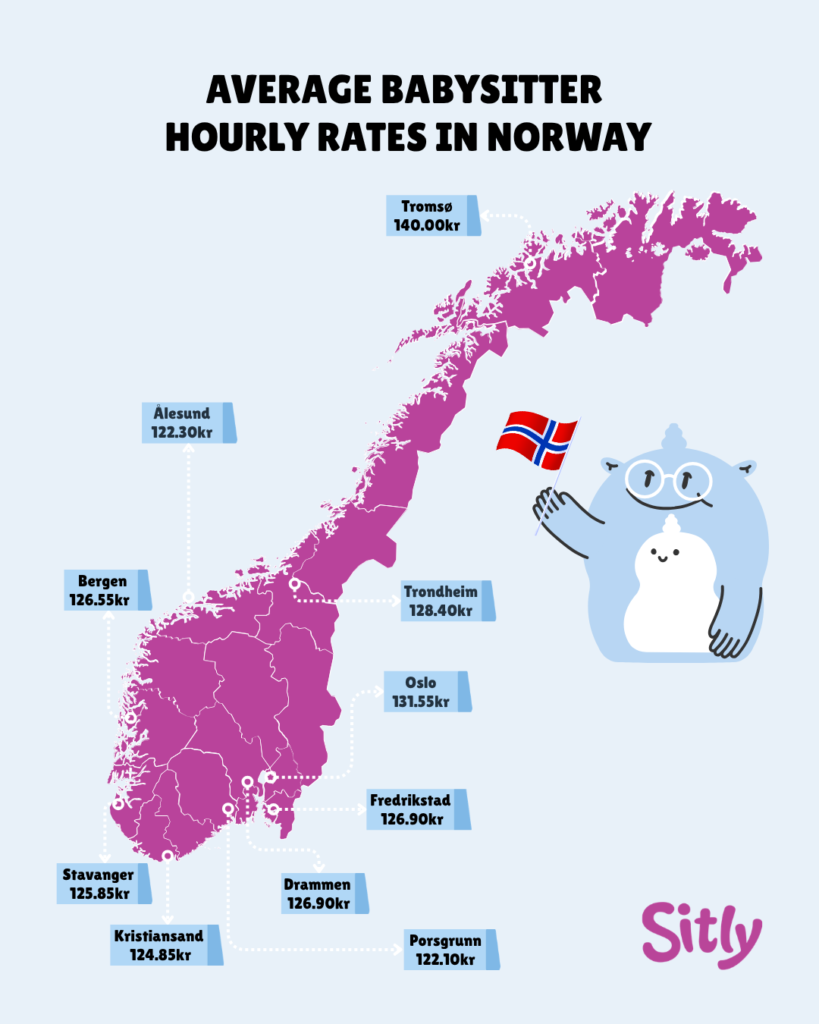
| City | Average hourly rate |
|---|---|
| Tromsø | KR 140.00 |
| Trondheim | KR 128.40 |
| Oslo | KR 131.55 |
| Drammen | KR 126.90 |
| Fredrikstad | KR 126.90 |
| Porsgrunn | KR 122.10 |
| Kristiansand | KR 124.85 |
| Stavanger | KR125.85 |
| Bergen | KR 126.55 |
| Ålesund | KR 122.30 |
Why do babysitter rates vary from city to city?
As the figures show, babysitter pay can vary considerably from city to city, and the reason often lies in the balance between supply and demand:
In areas where there are many babysitters but fewer families needing help, rates tend to be lower. Conversely, in cities where many families are looking for a babysitter but there are few available candidates, rates will typically be higher. If you want to set a fair rate in your area, it is always a good idea to talk to other parents you know: neighbours, friends, or parents at the nursery. This will give you a more realistic picture of what is an appropriate hourly rate for a babysitter in your local area, taking into account experience and qualifications.
So, how much should you pay your babysitter?
There is no single correct answer to how much a babysitter should earn. The right amount depends on a number of factors: the babysitter’s age, experience, and qualifications; the number and age of your children; any additional tasks; the time of day and the city you live in. And of course: your budget.
Ultimately, it is about finding the right balance between the babysitter’s expectation of fair pay and the family’s actual needs and financial situation. The most important thing of all is communication: be clear and open about your expectations, about the tasks to be carried out, and about what you are able to pay.
That way it is much easier to reach an agreement that feels fair to both parties and that creates a good and safe working relationship around your children.
Table of contents


FAQS

In 2025, most parents in Canada pay between $16 and $22 per hour for a babysitter. Rates vary depending on your location, the sitter’s experience, and the number of children. In big cities like Toronto, Vancouver, and Ottawa, babysitters often charge closer to $20–$25 per hour, while smaller towns or rural areas may see rates around $15–$18. If your babysitter has first aid certification, childcare training, or many years of experience, expect to pay at the higher end.
The average babysitting rate in Canada is around $18 per hour, according to Sitly’s data. However, the national average hides big regional differences — for example, Vancouver and Toronto often have the highest rates, while cities like Winnipeg or Halifax are slightly lower. Many families also adjust pay based on the sitter’s age, reliability, and duties (like bedtime routines, meal prep, or homework help). For occasional babysitting, parents typically pay hourly; for regular weekly help, some negotiate a flat rate.
Yes, most babysitters increase their rate when caring for more than one child. The typical increase is $1–$3 extra per hour per additional child, depending on their ages and needs. For instance, managing a baby and a toddler at the same time often requires more attention than watching two older kids. Some babysitters set a flat hourly rate that covers up to two children, and then add a small supplement for each extra one. Discussing expectations early — including mealtimes, bedtime, and any special routines — helps avoid misunderstandings and ensures fair pay for the workload.
Overnight babysitting rates in Canada depend on how many active hours are required. Many parents pay a flat fee between $80 and $150 per night, or an hourly rate until bedtime (usually $18–$22/hour) plus a reduced hourly rate for sleeping hours. If the sitter needs to wake up to feed a baby or attend to young children during the night, it’s fair to increase the total amount. Providing meals, a comfortable sleeping space, and transportation is also standard. For regular overnight care — such as when parents work night shifts — a negotiated weekly rate can be more practical.
Babysitter rates in Toronto and Vancouver average $22–$27 per hour, among the highest in the country. The higher cost of living and strong demand for reliable childcare increase rates, particularly for sitters with CPR certification or childcare experience.


Trusted sitters, right around the corner
Need a little help? Sitly connects you with experienced babysitters in your area. Whether you need occasional or regular care, finding the right babysitter is super easy. Browse profiles, read reviews, and reach out to your favorites right away.

Related Articles

When is a baby old enough for a babysitter?
Wondering when your baby is old enough for a babysitter? While there’s no single “right” age, short and gradual separations are possible even in the early months when the babysitter is experienced and routines are respected.

Calculate Your Babysitter’s Rate with the Sitly Calculator
Find out how much to pay a babysitter in your area. Sitly’s Babysitter Rate Calculator shows average rates across Norway and helps you estimate a fair hourly wage based on your city, number of children, and any extra duties.

10 Ways to Help Your Child Overcome Fear of Monsters at Bedtime
If your child is afraid of monsters at bedtime, you’re not alone. Many kids aged 3 to 6 struggle with nighttime fears fueled by imagination and change. In this article, you’ll learn why these fears happen, how to validate them, and 10 simple, creative ways to help your child feel safe and sleep peacefully. From using nightlights and comforting routines to anti-monster sprays, magic spells, and stuffed animal bodyguards—each idea is designed to reduce anxiety and empower your child at night.